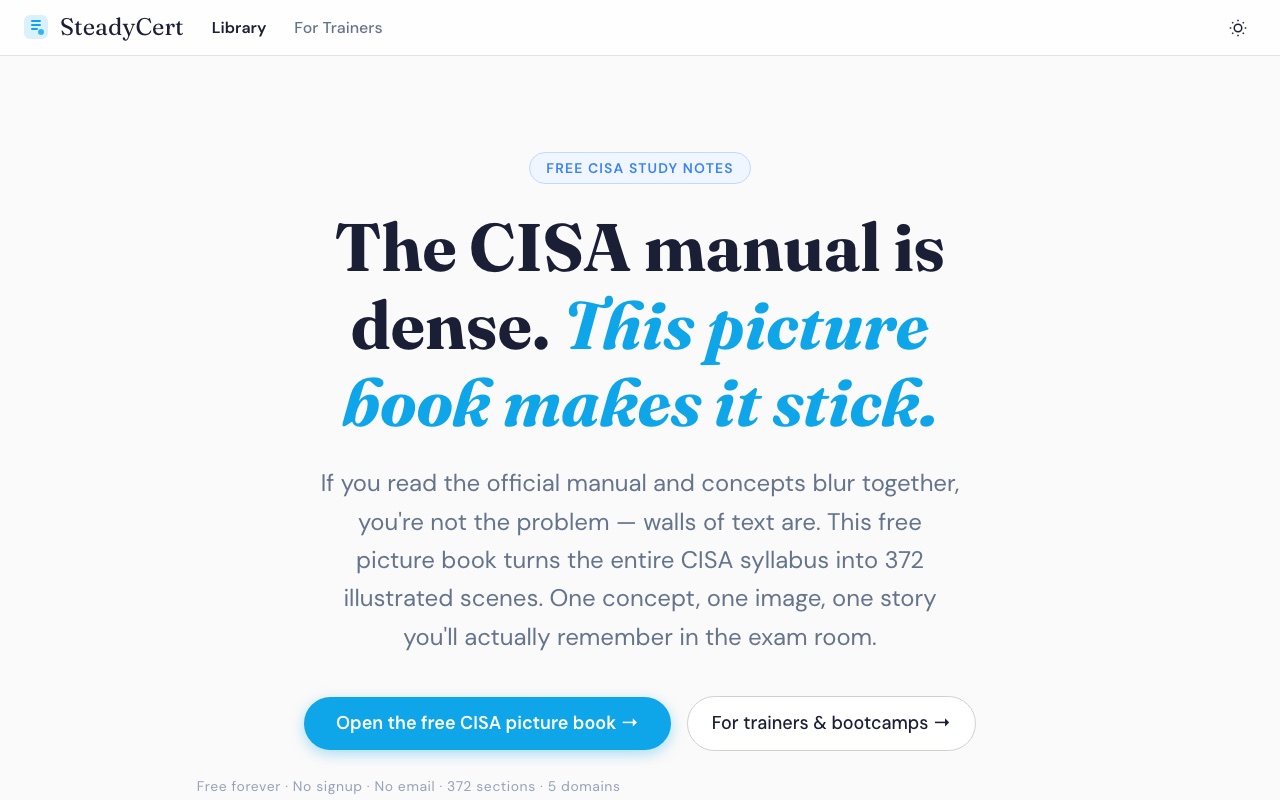
The CISA review manual is 800+ pages of dense text: audit risk formulas, control frameworks, sampling methods. I kept forgetting things I had read the day before.
So I built the version I wanted, where every concept is attached to something I could picture.
The whole book is one long exercise in the same thing: audit is the discipline of asking whose interests a control actually serves, and whether the answer still holds once someone has a reason to work around it.
- What it is
- A picture-book study guide for the CISA exam. 5 domains, 372 illustrated sections, 372 practice questions.
- Also in it
- 326 mnemonics and 64 real-world cases.
- Access
- Free to read. No signup, no email, no paywall anywhere in it.
- Not
- The official manual, and not a substitute for the syllabus. The illustrations are generated, then checked by hand.
Why I built it
Material this dense fails in a specific way. It is readable, and nothing stays. The information is correct and complete. A day later you can recall the shape of the page, but not what was on it. Reading it again is the usual answer, and it is why people spend months on a manual they have already read twice.
What I wanted was one memory hook per concept. A treasure map for audit planning. A detective agency for the types of audit. A lighthouse for quality assurance. The image does the work of recall, which is the part the manual leaves entirely to you.
I built the study tool I wish existed, so studying doesn't feel like reading a phone book.
What it does
Every concept gets a story. That is the whole design. 372 sections across the 5 CISA domains. Each one has the illustration, the concept in plain language, and a mnemonic wherever the material is a list you have to hold in order. Then 372 practice questions, so reading and recall are not two separate exercises done weeks apart.
It is deliberately thin on infrastructure. No login, no account, nothing to sign up for. You open it and read.
How it is put together
The illustrations come from AI image and language models. Then I go through each one myself. Two things to check: whether it is accurate to the concept, and whether it actually helps the concept stick. The second one is the one that fails. An image can be perfectly correct about audit sampling and still be forgettable. That makes it dead weight on the page, not a hook.
That review pass is where the time went. Generating 372 illustrated sections is cheap. Deciding which of them earn their place is not. It is the difference between this and a pile of generated content.
The guide is free in full. I was studying for the exam myself, and a paywall between a student and their revision is the kind of friction that leaves a tool unused. Keeping it open also means I find out whether it is any good, from the people using it.
Where it stands
Live at steadycert.com, with a steady trickle of readers over the months. A few have emailed real suggestions and corrections. That is more feedback than I expected for something I built mainly to study for my own exam. PMP is next, with CISSP and Scrum after that, because the format is the transferable part.
Get in touch
If you are studying for CISA, or you want something like this built for another exam, I would like to hear about it. Same goes for anything else on this site.
Email me or find me on LinkedIn. I usually reply within a day or two.